

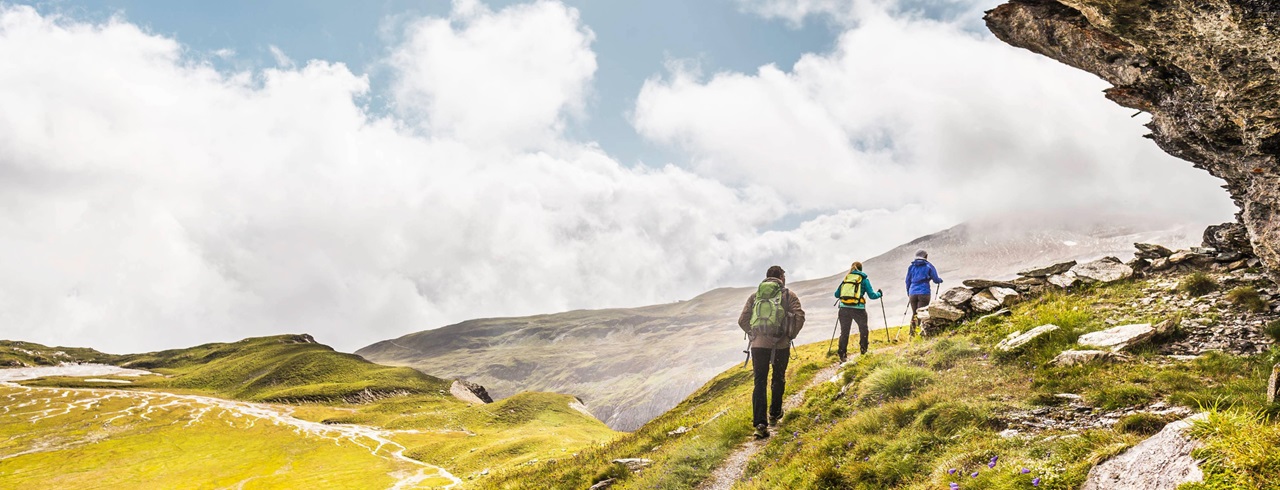
Enjoy hiking in spring without any nasty surprises

Fabian Reichle
Spring is here, and with it the start of hiking season. However, anyone enthusiastically setting their sights on distant peaks at this time of year should do so with caution. While nature may be showing its greener side and the sunshine beckoning to you in low-lying areas and valleys, conditions at higher altitudes can often still be wintry – with all of the very real natural hazards that entails. But these aren't the only factors that can make hiking in the spring more difficult.
Out in the wilds – especially in the mountains – every season has its own perils. Spring is not necessarily any more dangerous than summer, autumn or winter. You just need to be aware of the conditions. If you bear this in mind and plan your walks carefully, a spring hike can be the perfect opportunity to experience first-hand how nature is coming alive, and witness the myriad ways it emerges from winter.
Snow patches: treacherous hangover from winter
Depending on the weather, you should expect snow at altitudes as low as 1000 metres above sea level in the spring. Snow patches may persist well into the summer due to precipitation patterns in the colder months and topography (such as on mountains' northern flanks or in shady couloirs).
In addition to the risk of slipping when walking on snowy paths, avalanches still also pose a real danger. So it's essential to check the avalanche bulletin before you set off and, depending on the terrain, make sure you pack crampons or microspikes and walking poles in your rucksack.
Take special care with "snow bridges", which often span meltwater channels or streams that hollow out the snow underneath. They can collapse as you cross them, and the dangers are not apparent to the casual observer.
Other factors you need to pay attention to when walking in snow-covered areas are time, orientation and fatigue. Paths and waymarkers are often hidden by the snow, which usually makes progress slower and more arduous. Allow additional time for your hike, including plenty of time for breaks.
Snow melt: when streams become rivers
Snow is a source of danger in mountains and foothills, but water can also pose a threat. The large volume of meltwater can quickly turn small rivulets into raging torrents. This is particularly important to bear in mind when hiking in gorges. Even seemingly innocuous stream crossings can become impassable obstacles, leaving you no alternative but to take another route or turn back.
Spring hiking kit
- Layered clothing, including windproof and rainproof layers
- Winter wear such as a warm jacket, gloves and hat
- Sun cream with a high UV protection factor and dark sunglasses
- Trekking poles and, depending on the snow conditions, crampons or microspikes
- Insect/tick repellent
- All the standard kit such as food, first aid kit, maps etc.
Weather: be prepared for anything
The weather is often changeable in spring. While the temperature may be a pleasant 20 degrees Celsius at the start, it could plunge to as low as freezing point at higher altitudes. It's therefore advisable to dress in layers, and pack a warm jacket, gloves and headgear.
Thunderstorms can also occur at this time of year so rain protection is useful. It is essential not to be exposed out on the mountain during a storm. In spring, the weather is usually most settled in the morning, so it's a good idea to make an early start.
Spring hiking kit should also include sun cream with a high UV protection factor, because skin will not be used to the stronger rays, and sunglasses to protect the eyes – especially against the glare from snow.
Huts and mountain railways may still be closed
Lots of services in the mountain regions don't reopen until later in the year, or undergo maintenance in spring. It's therefore advisable to check in advance whether huts and mountain railways are staffed and/or operating, especially if you're planning a longer hike. Official websites are the best sources of information, such as the tourism regions' websites or the SAC hut portal.
Hiking at lower levels: precarious ground and nasty critters
.jpeg?mw=512&hash=842A5D13D5B41D821F0028C0251C8121)
If you always stick to altitudes where conditions are green and mild, there is another aspect you need to take into consideration: most hiking trails are poorly maintained or not maintained at all over winter. They may be overgrown and are often covered with leaves or branches which obscure the ground and can cause you to slip. If a hiking trail is closed, it will be marked on the official Swiss maps. This may happen at any time of year.
Summary: the most important tips for planning spring hikes
- If you are uncertain, it's better to turn back or reschedule for a later date.
- Plan hikes that are suitable for your fitness level.
- Allow plenty of time and set off early in the morning.
- Check the weather, snow situation and avalanche bulletin before you set off and keep an eye on the forecasts.
- Consult webcams, tourism and mountain railway websites, SAC hut information and up-to-date hiking reports.
- Look out for snow and water (above 1000m above sea level and in gorges). Locate streams that might potentially carry a lot of water on maps beforehand and avoid snow bridges. Always reassess the terrain and the situation when you get there.
- Watch out for unmaintained paths and respect trail closure signs.


