

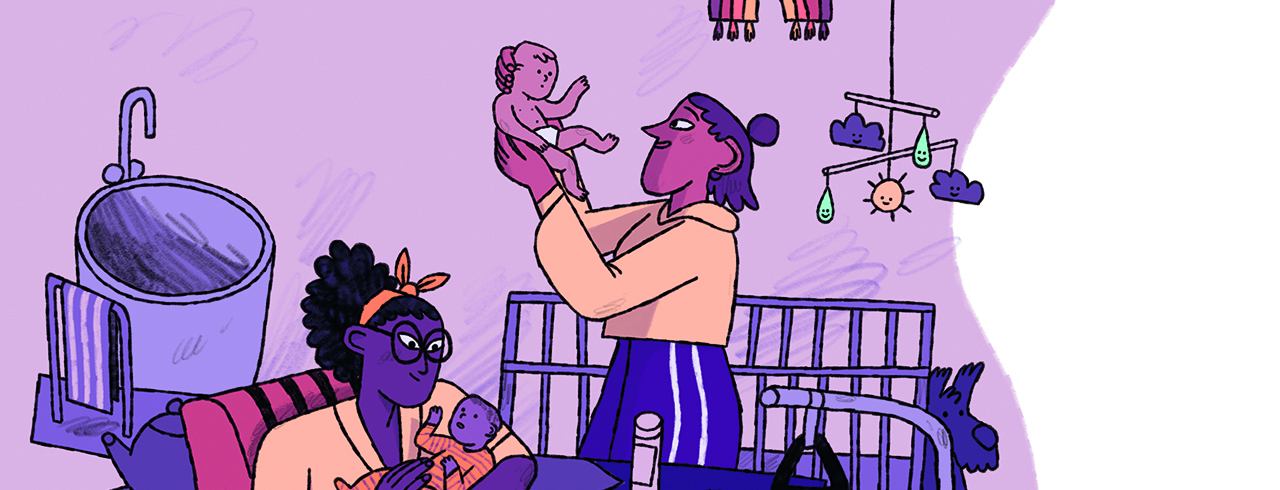
Where should my baby be born?
What kind of surroundings do I want to give birth in? This is a question most pregnant women ask themselves, because there are big differences between hospital births and those in a birth centre or at home. Many women view hospital birth as the safest option, as there are midwives, nurses and doctors on hand 24 hours a day in case of emergency and they can offer comprehensive care for mother and newborn after the birth. «In fact, according to the Midwifery Association, 98% of all births in Switzerland take place in hospitals,» explains Lisa Bammatter, midwife and media spokesperson for the Winterthur Birth Centre. In contrast to a birth centre, care in a hospital can be impersonal. The expectant mother doesn't usually know the staff, and if lots of women go into labour at the same time, the ward can get hectic.
Delivering at a birth centre or at home
Giving birth in a birth centre is more personal. There are usually one or two midwives present who the woman has already got to know during her pregnancy. An even more intimate experience is a home birth, where the mother is in a completely familiar environment. However, birth in a non-clinical setting is only advisable for women who have had normal pregnancies. It is not suitable if the baby is in a breech position or if the mother has gestational diabetes or is carrying twins. It's also worth bearing in mind that strong pain relief such as an epidural cannot be given. One woman in five is transferred to hospital during childbirth because she needs stronger pain relief. «On the other hand, it's increasingly common for women to be transferred to a birth centre after delivery so they can spend the postpartum period there with their baby,» adds Lisa Bammatter.
Expectant mothers and fathers often have concerns about the safety of giving birth in a birth centre. «Such fears are unfounded,» explains Lisa Bammatter. «Birth centres practise evidence-based maternity care, operating in accordance with clear guidelines and usually in close cooperation with nearby hospitals. In Winterthur, we work closely with the specialists at the cantonal hospital so that we can guarantee the safety of mother and child at all times.» But she wouldn't want to talk anyone into choosing this option: «Anyone who would feel more comfortable in hospital should definitely go there. The important thing is what's right for the mother, and that she should have every option open to her,» says the midwife.
What’s nearby?
Where a woman gives birth depends to a large extent on what's available locally. According to the Swiss birth centre association (IGGH-CH), there are only eleven birth centres in German-speaking Switzerland, ten in French-speaking Switzerland and one in Ticino. So there may not be one close to the expectant mother's home. In addition, only a small number of independent midwives offer home birth support, because they have to be available on demand, which requires a great deal of flexibility in terms of time. With the opening of the Winterthur Birth Centre in 2023, expectant mothers in this region who feel a home birth is not for them now have another alternative to hospital birth. As a sponsor of the Winterthur Birth Centre, SWICA is helping to support a comprehensive health infrastructure in the town where it is headquartered.
Financially well protected
For the mothers, there is no difference between the various types of birth in terms of cost. If the birth centre is on the hospital list for the canton, all costs, including inpatient benefits, are covered by basic insurance. Even if the mother is transferred from the hospital to the birth centre after the birth, the postnatal care costs for mother and child are covered at a flat rate.
SWICA’s pregnancy and childbirth benefits
Basic insurance
There are many checkups throughout pregnancy and after the baby has been born. To ensure that mother and child are fully cared for and financially protected, there is no co-payment for maternity benefits under basic insurance. Basic insurance covers the following benefits:- Antenatal courses (150 francs towards group courses by a midwife)
- 7 antenatal checkups
- 2 ultrasound examinations
- 1 postnatal checkup
- 3 sessions in which midwives or other specially trained staff provide breastfeeding advice
- For high-risk pregnancies, the interval between examinations is based on clinical need
Supplementary insurance
The Completa Top/Completa Forte and Praevita supplementary insurance plans offer additional comprehensive benefits for birth preparation, care and follow-up support:Completa Top/Completa Forte
- 200-franc breastfeeding benefit per child
- Complementary medicine: SWICA reimburses the services of therapists we recognise up to a maximum of 80 francs per hour * under its Completa Top plan or 120 francs per hour * under Completa Forte.
- Medication, within the indication, as prescribed by a doctor *
- Baby swimming: 90% of the costs, up to 300 francs per year, under Completa Forte
Praevita
- Medically prescribed vaccinations for children that are not covered under mandatory insurance: 90% of the costs, up to 200 francs per year
- Baby swimming: 50% of the costs, up to 300 francs per year
Wide range of courses
SWICA covers 90% of the costs under Completa Forte and 50% of the costs under Praevita, in both cases up to a maximum of 500 francs per year (up to 300 francs per activity type).
Courses for mothers:
- Pregnancy exercises**
- Antenatal preparation**
- Post-natal exercises**
Courses for mothers and fathers:
- Baby massage
- Homeopathy and Bach flowers for self-application
- Wraps and compresses
**With SWICA-recognised course leaders


